How I set the line between what the research supports and what a wellness app should claim, and built the page that holds it.
AI Product Consultant & Fractional Lead · Ex-PayPal
Turning AI prototypes into launch-ready products for real users and regulators
Founder of Duskglow, an AI journaling companion in live beta. Built solo over six months: product, safety design, encryption, and compliance work for the California, New York and Washington AI companion laws. Developed with AI coding agents under a written approval and review process.
Previously nine years at PayPal. Product Manager for the internal onboarding tool, built from scratch with a team of four; IT and support load down 30% over five years. Senior Manager for the global onboarding program across HR, IT, security and workplace teams: support tickets down 50%+, manual tasks down 25%.
Engagements
- 0-to-1 AI product builds: product definition, architecture, delivery
- AI launch readiness: crisis handling, guardrails, adversarial testing
- AI regulation translated into product requirements
- AI coding-agent workflows with approval and review controls
- Model selection and LLM cost management
- AI automation for internal operations: support, onboarding, HR
Available for fractional and advisory work.
Case Studies
AI Agent Workflow
What I Let the AI Agent Touch
One founder and an AI coding agent shipping a regulated AI app, with the controls built into what the agent can touch.
- Four permission tiers, sorted by reversibility
- Read-only database access for the agent
- Checks triggered by claim type, not confidence
10 min readRead case study →
AI Companion UX
Designing Luna
Designing a bedtime AI companion required solving a tension most AI products ignore: how to be emotionally present without becoming emotionally necessary.
- Three-tone personality framework
- Five-iteration system prompt architecture
- Emotional dependency guardrails
14 min readRead case study →
Safety Architecture
Proving Luna Is Safe
The safety infrastructure required more engineering than the AI behavior itself, and a testing philosophy that treats false positives as correct behavior.
- OWASP-mapped 11-layer security pipeline
- 100+ case adversarial suite
- Crisis detection that bypasses the LLM
16 min readRead case study →
Privacy & Compliance
Compliance Work for Three AI Companion Laws
Three state AI companion laws, read from the enacted text instead of the summaries, turned into eleven requirements and shipped in a week. No page claims a compliance status.
- Three statutes read from the text; a dead bill found quoted as law
- Eleven requirements with basis, status, gap, owner and effort
- A referral count that survives deletion and leaves out test runs
12 min readRead case study →
The Product
Duskglow
Nightly Gratitude Journaling with Luna
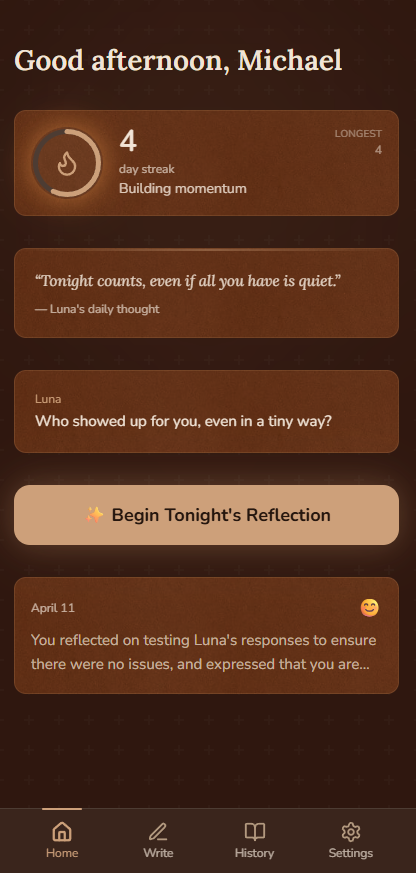
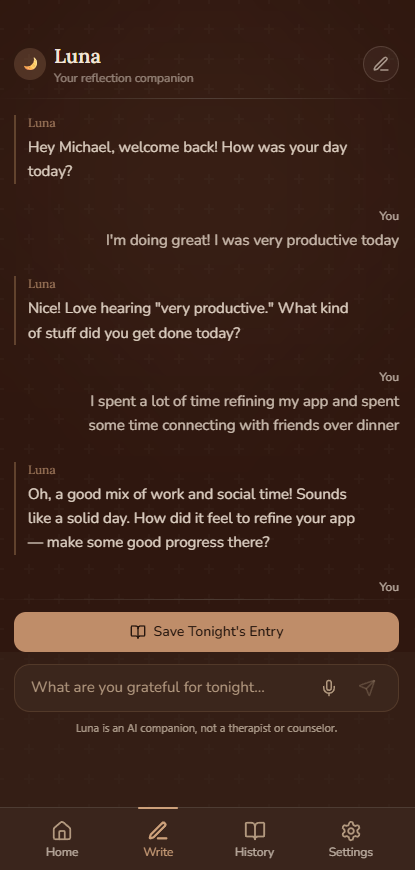
A mobile-first PWA for nightly gratitude journaling, powered by an AI companion named Luna. Built solo from architecture to deployment: React, Supabase, Gemini 3.5 Flash-Lite, and a multi-layer safety pipeline.
Start Here
- My Privacy Policy Described an Export the Code Didn't Build
My privacy policy said the data export held a user's entries, and the code that builds the file showed it left the reflections out.
- Testing an AI App's Crisis Response From the User's Side
An audit of who can write what in my app's database turned up a crisis reply that sat behind a rate limit, where the safety suite could not reach it.
- Shipping a Legally Required AI Disclosure People Actually See
Shipping a statutory AI-disclosure notice into a companion app's chat thread, and how reading the code changed the design record's mechanism without changing the promise.
- Four Weeks to Replace the AI Model Behind My Companion App
A vendor retired the model behind the companion with four weeks of notice, and the migration came down to which instruments I actually own.
- What 'Done' Means When an AI Writes the Code
How a non-engineer PM verifies delegated technical work, and why the cleanest 'all done' report is often the one worth checking hardest.
- The Rule My AI Collaborator Kept Breaking, and the Fix That Held
Why a recognition-triggered confidence rule kept failing on the same kind of claim, and what shipping a structural backstop taught me about scaling solo founder leverage through delegation.
Journal
Filter by keyword or select a tag.
Why I shipped a small encryption change as two releases, and how a mistake at the smoke test proved the reversibility I had designed for.
How I decided whether to encrypt a readable summary field before a beta, by measuring the premise I had written down a few hours earlier.
An onboarding screen and a law summary went unchecked against their sources, a temporary setting outlived its test, and none had a date to be checked again.
A design note, a vendor's documented fix and my own mock-up were each wrong in one day, and each time only a real run showed it.
Shipping a home screen redesign, and how a layout bug and my own vague feedback both pointed at the same real problem.
Replacing an AI sparkle logo, and why I picked the new mark by listing where it could fail instead of where it looked best.
Redesigning a companion app's home screen so it reports the user's state without scoring them, and what five rounds of mock-ups changed.
Reordering a build queue after realizing a metric I had waited two sessions for was never going to arrive, and what else reads as fine when nobody checks the pipe.
Picking where a chat control lives by asking which state the user is actually in, and what the smaller fix would have quietly removed.
Measuring where a chat turn's cost went before cutting, and learning that fixing Luna's repeated questions had only moved the repetition to my side of the conversation.
A wording pass on Luna's questions surfaced a hidden defect, replies cut mid-sentence by a token ceiling the test suite had no rule to catch.
Deciding how search works in an encrypted journal, and finding that the option I had feared for three months was already live in a feature I had shipped.
Shipping a morning notification in the user's own words, built so the service that sends it never has the text, and the two failures that made it real.
Adding reminders to a private journaling app meant deciding what a notification is allowed to know, and proving the answer before anyone could opt in.
Shipping an end-of-night intention taught me where precision helps a product and where it quietly turns into a liability.
Why a journal that talks back should still open on the writer's own words, and what a one-word disclosure taught me about shipping.
Why I moved the age gate behind a public landing page, and what two wrong conclusions about a blocked review taught me about stopping too early.
How I closed the data-loss gap I had been carrying since June, which gate I skipped on evidence, and what the first post-deploy failure taught me about blame.
How I encrypted every existing journal in a deploy that could not be rolled back, and why an un-undoable change inverts the whole release process.
Why I built the test that proves a one-time, irreversible data migration correct before I built the migration itself, and what that proof had to cover.
Why the recovery cues for an unfinished journal entry show no content, and why the exit popup gives people a real way to discard and leave.
Why I kept the companion's memory field as readable text while the entry itself is encrypted, and how I filtered it to earn that choice.
Designing recovery for when a user loses their encryption key, where both resetting the key and locking them out are the wrong move.
How I sequenced verification and approval for the least reversible change in the project, an encryption rollout that reached every user at once.
Why I retired a plaintext draft-saving shortcut instead of patching it, and built a replacement that saves drafts only in encrypted form.
Three decisions in one stretch of encryption work, each forcing the same choice: design honestly for the reality you have, not the one you wanted.
Why I deferred Duskglow's privacy and terms pages until the encryption architecture is built, instead of shipping disclosure copy I would only have to rewrite.
A runtime mismatch in production telemetry surfaced via mandatory verification, and what it reveals about the structural discipline that catches what recognition-based judgment cannot.
How a single beta tester report rejected the 'monitor and see' default and surfaced a reframe of how the product treats in-flight state.
A 30-second schema check found a column-type bug that would have silently killed telemetry on the low-memory devices it most needed to see.
An exploration session testing whether you can prompt your way out of an AI tool's house style, run on the tool itself.
A couple moments today taught me the same lesson from different angles. AI tools have defaults that compound into your product, and noticing them is becoming part of the PM job.
When a voice input bug surfaced on a phone but not on the laptop where the code lived, the question wasn't what to fix. It was how to see what was actually happening.
A regression closed without a real fix, an AI agent that surfaced tension instead of choosing silently, and a governance rule whose premise had quietly expired, all in one day.
A five-element structure for delegating technical decisions to an AI collaborator when you own product vision but cannot verify the code yourself, built live during a cryptographic ship.
Why replacing a working development tool mid-project, before finishing in-progress ship work, was the right sequencing call for my AI-assisted build loop.
A UI task turned into a pressure test of every trust assumption in the encryption posture, and why that pressure test is the real work.
An admin dashboard is a product for one user and a liability for everyone else, and that reframing changed what I built and what I turned off by default.
Twelve chats turned safety infrastructure into three case studies, and the translation process surfaced product decisions the building process missed.
An eight-session sprint to feature-completeness where the hardest PM decisions were what to revert, where to draw API boundaries, and when to override your own AI's design instincts.
How mapping real AI companion lawsuits to OWASP vulnerability categories produced four concrete Edge Function fixes deployed in a single session.
Building working memory into an AI companion, letting the model author its own UX signals, and why a 429 error in a journaling app hits harder than a loading spinner.
A stateless search architecture that eliminates the vector database entirely, compliance features designed as architectural patterns instead of checkboxes, and managing AI development context as production infrastructure.
Migrating off a no-code platform mid-build, designing a summarization feature as a side-channel architecture, and the debugging tax that comes with every AI-generated line of code.
Why crisis detection must bypass the LLM entirely, how adversarial testing exposed the cost of false positives, and building an AI personality framework where tone carries real risk weight.
Seven security layers mapped to OWASP LLM Top 10, a system prompt rewritten as a behavioral spec, and the discovery that your safety infrastructure can fight itself at the worst possible moment.